Moisture in the construction industry: How 2025 data can change risk management
Moisture has long been one of the construction industry’s most overlooked risks. Invisible, underestimated, and yet consistently linked to costly failures, moisture is no longer just a technical concern; it’s a strategic factor that affects schedules, budgets, and insurance premiums.
As projects grow more complex, sustainability standards tighten, and expectations for building performance rise, relying on assumptions or occasional checks is no longer enough. In 2026, real insight into moisture isn’t optional, it’s essential. It demands real-time visibility, actionable data, and proactive management.
At Tector, our sensors monitor over 220 projects across 20+ countries, capturing more than 10.6 million moisture readings in 2025, up from 8.7 million in 2024, a 21% increase year-on-year. This dataset reveals clear patterns in moisture behaviour, helping teams identify risks early, take informed actions, and prevent hidden issues from becoming costly problems.
Why ignoring moisture costs projects time and money
Unchecked moisture quietly compounds. Hidden wetting can delay schedules, compromise warranties, inflate insurance premiums, and trigger expensive remediation. By the time moisture becomes visible, it often manifests as structural defects, mould growth, or legal disputes.
The impact is felt across every stakeholder:
- Contractors: face rework, delayed timelines, and disrupted programmes.
- Owners: encounter reduced asset value and higher operating costs.
- Insurers: see increased claim exposure.
- Occupants: experience compromised comfort, safety, and satisfaction.
Seasonal trends and high-risk elements
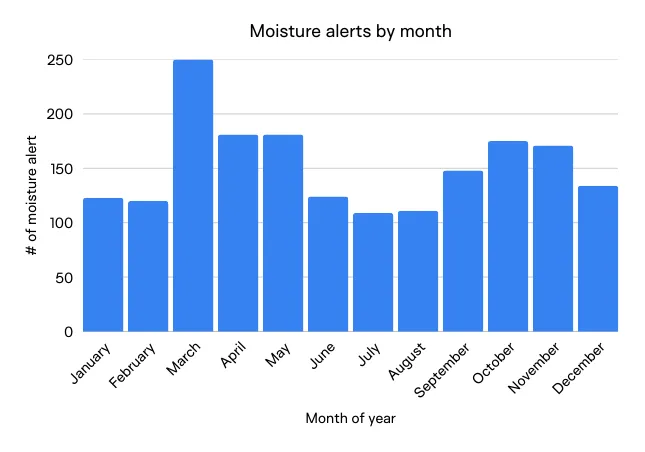
Our 2025 dataset shows clear seasonal patterns. Moisture alerts peak in early spring and late autumn:
- March: highest number of alerts (250) due to winter residual moisture and early-stage construction.
- October–November: spikes linked to rainfall, temperature changes, and condensation risks.
Analysing building elements highlights where moisture strikes most:
- External walls: consistently the highest alerts, especially in March, May, and September.
- Roofs: prone to leaks and seasonal moisture, with peaks in April and March.
- Load-bearing beams, columns, and slabs: hidden moisture here can compromise structural integrity.
- Interior walls: lower risk, but still require monitoring to catch early signs of mould or hidden moisture.
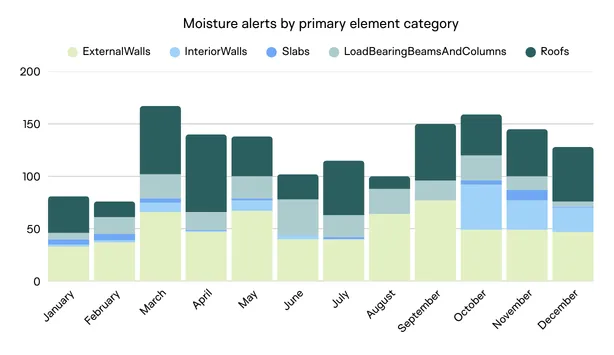
Understanding these trends allows project teams to schedule trades confidently, prevent delays, and reduce costly rework.
Regional moisture differences
Moisture levels vary significantly across regions, driven by climate, construction practices, and local conditions. Tector’s 2025 dataset shows:
- Denmark and the UK: Moderate, consistent moisture readings, with mean values around 15.1%. These numbers reflect steady exposure across large-scale projects, highlighting the need for ongoing monitoring even in moderate climates.
- Northern and temperate regions (Norway: 18.6%, Iceland: 17.1%, Sweden: 16.4%, New Zealand: 18.7%): Higher average moisture levels reflect wetter climates and more challenging weather conditions. These regions see shorter drying periods, making proactive monitoring essential to prevent hidden damage.
Understanding these regional patterns allows project teams to apply targeted strategies, ensuring moisture is detected early and prevented from causing costly damage, regardless of climate.
Two-layer protection: technical + digital
The data shows that some building elements consistently face higher moisture risks. To protect critical areas, Tector recommends a dual protection approach:
- Technical protection: membranes, coverings, drainage, proper sequencing, and drying strategies.
- Digital protection: continuous monitoring with intelligent sensors and real-time alerts.
This approach reduces rework, safeguards structural performance, simplifies compliance, and strengthens insurance positioning. It ensures moisture is both prevented and detected early, avoiding costly surprises.
Moisture and insurance: the hidden cost
Insurers consistently rank moisture as the leading cause of claims in timber and mass-timber projects:
- Excess moisture can cause dimensional changes, structural weakening, mould, and decay.
- Wood-frame projects often face 36–80% higher premiums than concrete, driven largely by moisture exposure.
- Early detection and documented moisture history can improve insurability, reduce premiums, and prevent costly claims.
From reaction to anticipation
2025 marks a turning point. Sustainability goals, liability scrutiny, and long-term performance requirements are rising. The companies that succeed will treat moisture as measurable, predictable, and controllable.
Proactive moisture management delivers:
- Confident scheduling and planning
- Reduced rework and programme delays
- Evidence-based decision-making
- Stronger insurance positioning and risk mitigation
Every project has a story, don’t let moisture ruin yours
Moisture is a critical factor in project performance, financial resilience, and long-term asset value. To see detailed seasonal trends, building element risks, regional differences, and actionable insights, download the full Tector 2025 Moisture in Construction Industry Report.