Moisture Risk in Modern Construction: What Every Project Team Needs to Know
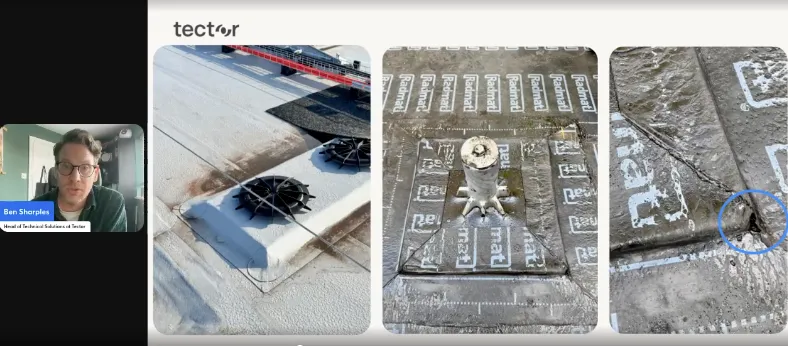
Hosted by Tector | Webinar Recap
Modern construction is evolving at a pace. The industry is embracing timber and biogenic materials, advanced prefabrication, and increasingly complex building systems, particularly in roof structures and building envelopes. These changes bring significant sustainability and efficiency benefits, but they also introduce a challenge that’s becoming harder to ignore: moisture risk.
Moisture has always been a concern in construction. But as building systems grow more complex and materials more sensitive, the consequences of poor moisture management are greater than ever. From hidden moisture accumulation in timber structures to vulnerable roof assemblies and failing building interfaces, even small oversights can lead to costly rework, delays, compliance issues, and long-term performance problems.
In our recent webinar, Tector’s Ben and Thijs van Tilburg explored how moisture risk is evolving alongside modern construction methods, and how intelligent monitoring can help teams get ahead of it.
The Scale of the Problem
The headlines tell a sobering story. A mass timber roof rotted through due to trapped construction-phase moisture, resulting in claims of up to £4 million. The Sky HQ project in West London is reportedly facing hundreds of millions in claims related to water ingress into its roofing cassette system. And last October, Awaab’s Law came into force in the UK, placing legal responsibility on landlords and developers to address damp, mould, and poor air quality in residential accommodation.
The published industry data reinforces the scale of the issue:
- 10% of total construction costs are lost to defects, and 69% of those defect claims are related to moisture penetration through the building envelope
- 3.3% of total construction cost is wasted on water ingress alone
- 2% of construction cost is spent on the roof, yet roofing accounts for 70% of water ingress claims
Tector’s own data from monitoring projects adds further detail: across their ten largest monitored projects (totalling roughly 40,000 m²), they recorded an average of over two leaks per project, with one leak occurring per 391 m², and one in ten of those leaks was only discovered after handover, despite the building being signed off as leak-free.
Why Biogenic Materials Change the Equation
The UK government’s Net Zero Strategy (2021) and the Timber Construction Roadmap (2025) both actively encourage greater use of timber and biogenic materials as part of the path to net zero by 2050. This is a positive shift, but it comes with implications for moisture management.
Timber and biogenic materials are hygroscopic: they absorb and release moisture. In larger, more complex timber buildings with high levels of prefabrication, it becomes harder both to keep rain out during construction and to seal the building without trapping moisture inside. The moisture issue is, quite simply, more critical than ever before.
Guidance exists to help, from the Structural Timber Association’s Moisture Management Strategy, to Timber Development UK’s construction document, the Mass Timber Insurance Playbook, and the new Model Building Guide from Waugh Thistleton. These resources address everything from material transport and site storage to protection during construction and ongoing monitoring once the building is watertight.
Internationally, certification schemes such as BREEAM, Passive House, LEED, NABERS, and the Green Building Council are also driving better moisture practice through accreditation requirements.
Where Moisture Risk is Highest
Understanding where moisture risk concentrates is key to protecting a project. Several areas stand out:
Flat Roofs and Terraces
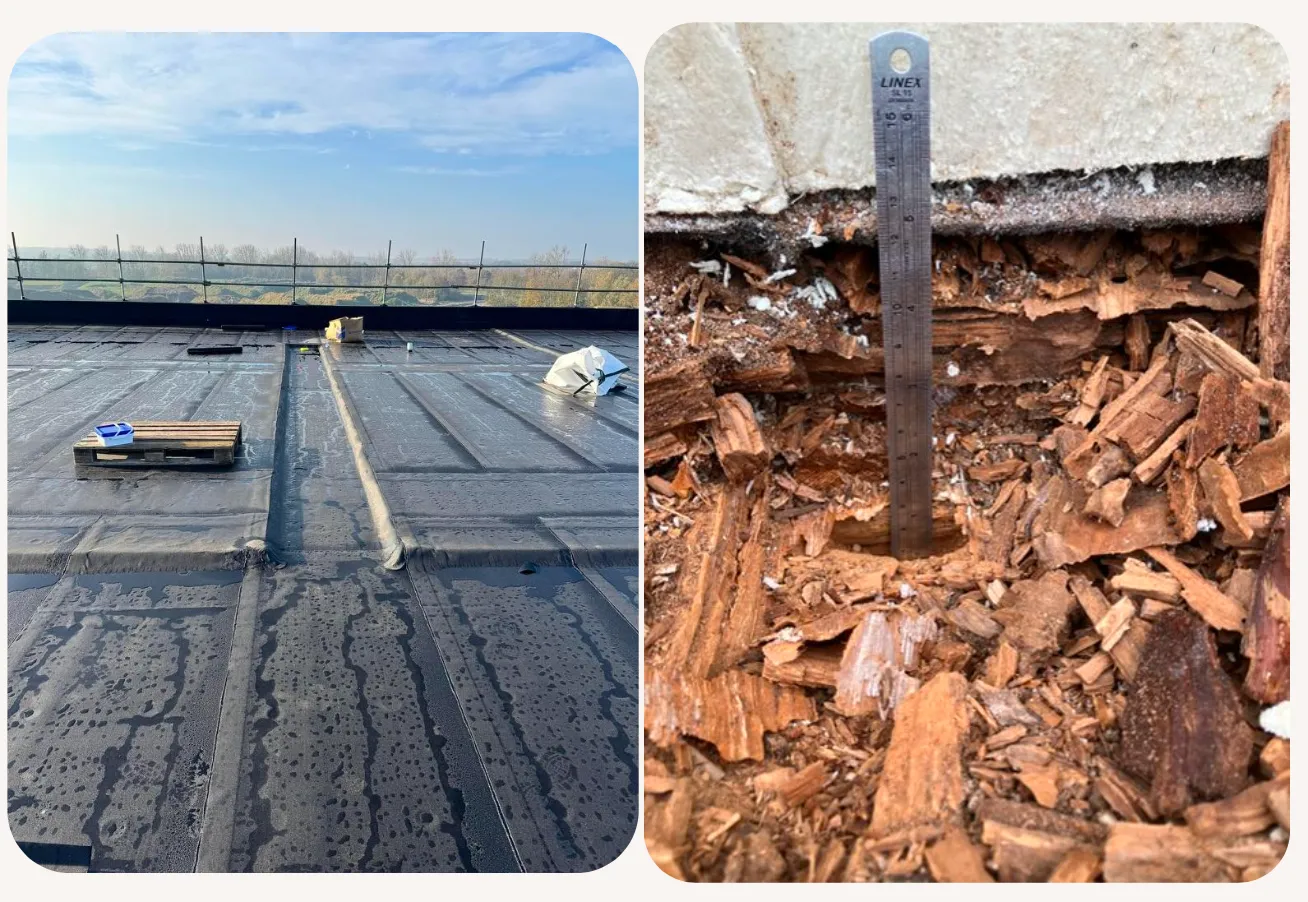
Flat roofs are the single highest-risk area for water ingress claims. Moisture penetrates beneath the waterproofing membrane, tracks through insulation, and accumulates on the vapour control layer, eventually finding its way into structural slabs. Because the moisture is sandwiched between materials with no drying pathway, leaks can go entirely undetected for years. A roof that looks perfectly intact from above may be silently decaying beneath the surface. At Oxford’s Jesus College Northgate House, sensors installed after historic construction-phase water leaks detected a further leak that was initially thought to have been fixed.
Modern flat roofs are increasingly complex. Solar panels, heat pumps, heat recovery systems, green roofs, blue roofs, and water attenuation systems are all becoming standard. Each addition brings more plant, more access requirements, more man-safe anchors, stanchion bases, and penetrations through the membrane - and each penetration is a potential failure point, especially with single-ply membranes where a single seal is all that stands between the building and water ingress.
Parapet Walls
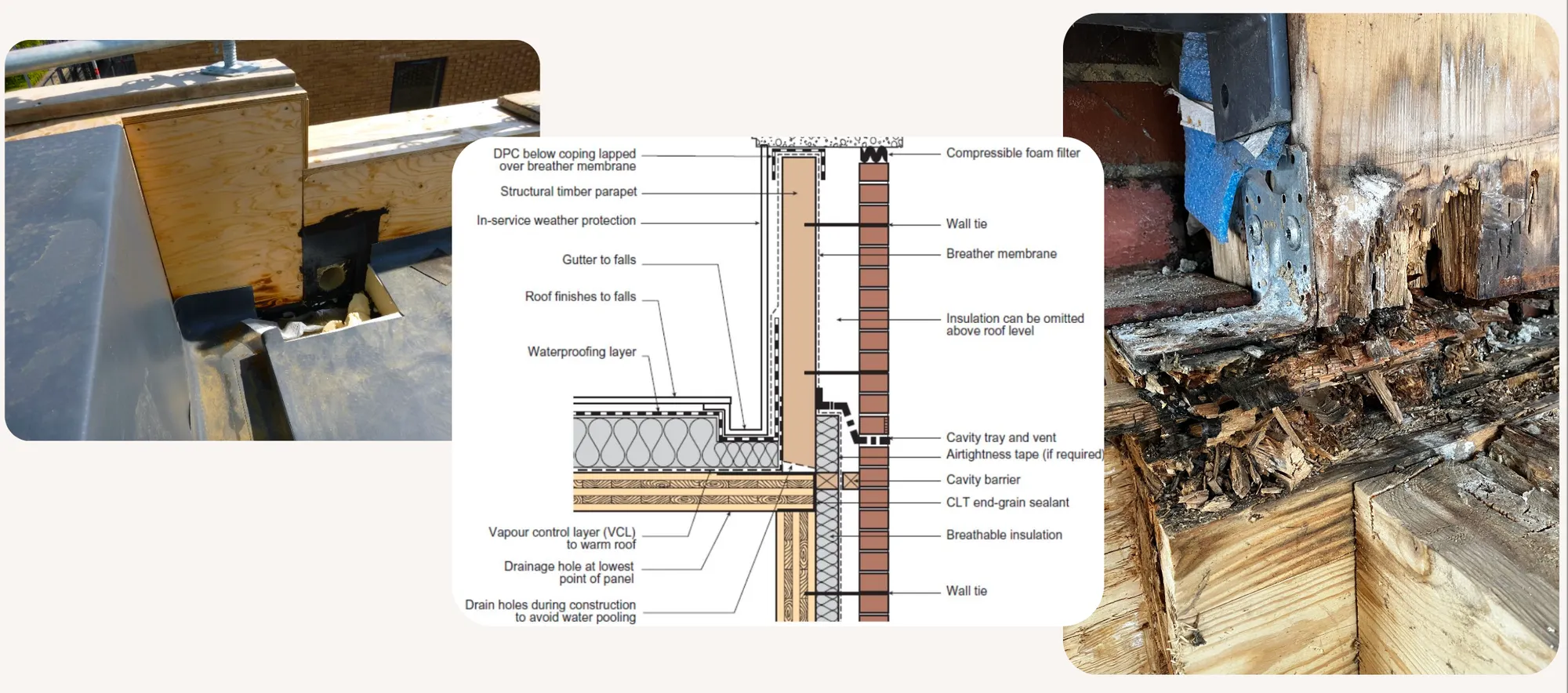
Parapet walls concentrate risk in a small area: a junction between a roof panel and a wall panel (both structural, both hygroscopic), a box gutter directing water precisely into that junction, multiple layers of membranes requiring correct lapping, capping pieces, cavity trays, and outlets through the wall. Each element is a detail that can fail, and when one does, the consequences can travel far through the structure.
Facades
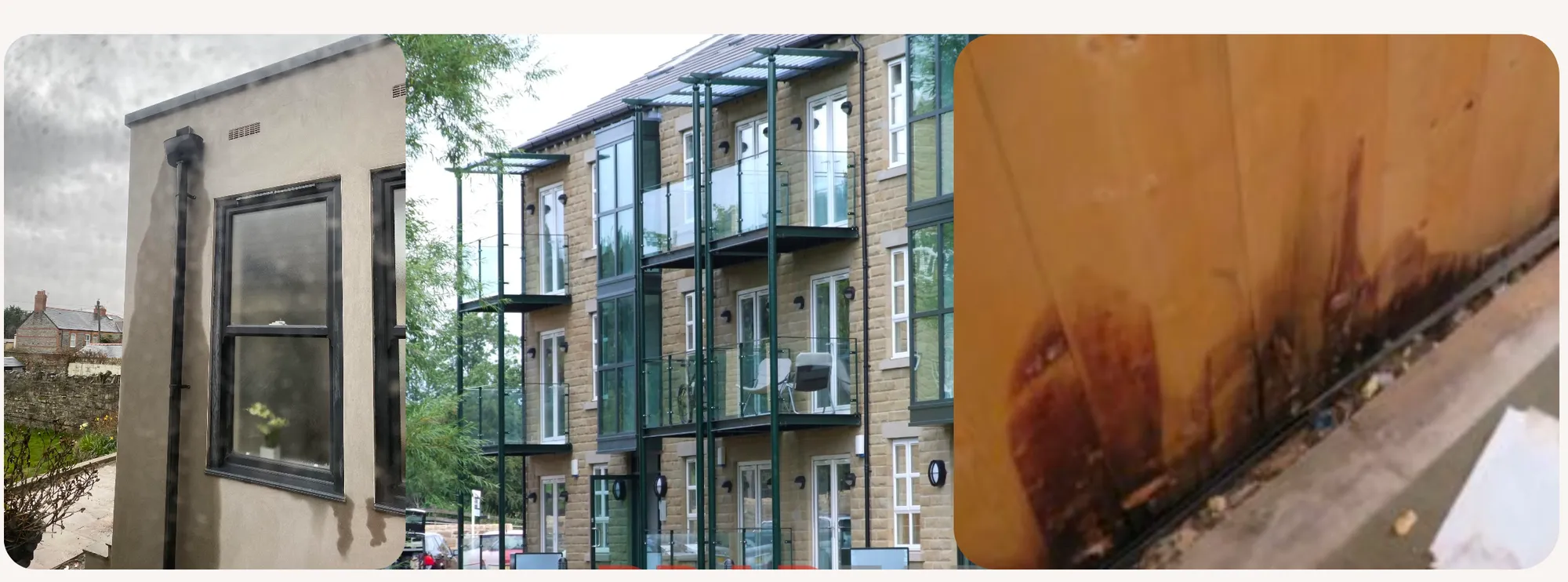
Rainwater outlets, balcony connections, and wall bases all create moisture pathways into facades. Overwhelmed or blocked hoppers can force water down the face of a building and into cavities. Ground-level or below-ground construction is vulnerable to splash-back and rising moisture, particularly where cavity trays or waterproof membranes haven’t been correctly installed, with the potential for fungal decay to silently eat into structural timber elements.
Wet Rooms
In mass timber, CLT, or modular buildings, wet rooms represent a particularly high risk. Tile seal failures, silicon breakdown around shower trays, plumbing leaks at wastes or feeds - these are small, common failures that can go unnoticed for extended periods. In a conventional home they’re a nuisance; in a mass timber building, the damage they cause over time can be severe.
The True Cost of Moisture Damage
When moisture damage does occur, the cost is rarely limited to the repair itself. Delays, access requirements, scaffolding (at Sky HQ, scaffolding costs alone are reportedly in the tens of millions), design of the repair scheme, loss of business earnings, and the challenge of decanting a hospital ward or a data centre, all of these compound the headline figure. The question of who is responsible for those costs runs through every phase of the construction process, and the answer is rarely straightforward.
From Data to Action: Real-Time Moisture Monitoring with Tector
The second half of the webinar turned from the problem to the solution. Thijs van Tilburg, co-founder of Tector, demonstrated how the platform translates real-time sensor data into actionable insights across live projects.
Tector deploys sensors that capture data up to six times per day, generating thousands of data points across a project. Three live project demonstrations showcased how this works in practice:
- Wet rooms and leak localisation, using moisture data to identify standout zones and pinpoint the source of a leak in a French project
- Machine learning and AI-driven pattern recognition, detecting subtle trend changes before they become visible problems
- Flat roof monitoring, tracking a developing leak and mapping moisture spread in real time, enabling early intervention before significant damage occurs
The value of real-time monitoring goes beyond early warning. It creates a traceable record of moisture conditions throughout the construction and operational phases, supporting accountability, reducing disputes, and providing evidence for compliance purposes. When a leak is detected, the team knows where to look, how quickly to act, and has a documented history to support any subsequent investigation.
Key Takeaways
- Timber and biogenic materials are essential to achieving net zero, but they require rigorous moisture management
- Flat roofs, parapet walls, facades, and wet rooms are the highest-risk areas on most modern projects
- Moisture damage often develops invisibly; by the time it’s visible, the cost of repair is far higher than the cost of prevention
- Real-time, traceable moisture monitoring turns environmental data into early alerts and clear decision-support
- Accountability for moisture damage spans every phase of the project - monitoring creates the evidence trail that protects all parties
Missed the live webinar? Watch the webinar recording on LinkedIn.