Hidden moisture in commercial flat roofs: where it comes from, the early signs, and where continuous monitoring fits
This article is about commercial flat and low-slope roofs - membrane roofs over insulation on offices, schools, logistics buildings, hospitals and residential blocks - and about the moisture that gets into them and stays out of sight. It explains where that moisture comes from, what the early signs are and what they cannot tell you, and where continuous, embedded, wireless monitoring fits. It is not a guide to inspecting or repairing a roof, and it is not about plumbing.
Why flat roofs hide moisture
Most modern flat roofs are warm roofs: a waterproofing membrane on top, insulation beneath it, a vapour control layer (VCL) beneath that, and the deck. It is a sealed, unventilated assembly with no drying path. That is what makes it work thermally, and it is also why moisture that gets in - from above, from below, or during construction - has nowhere to go. It sits in the insulation, migrates with temperature, and produces symptoms late and ambiguously.
The other design fact that matters is that the roof is out of sight. Nobody walks it daily, its underside is a ceiling, and by the time a symptom reaches a room the moisture has usually been there for some time.
Where the moisture comes from
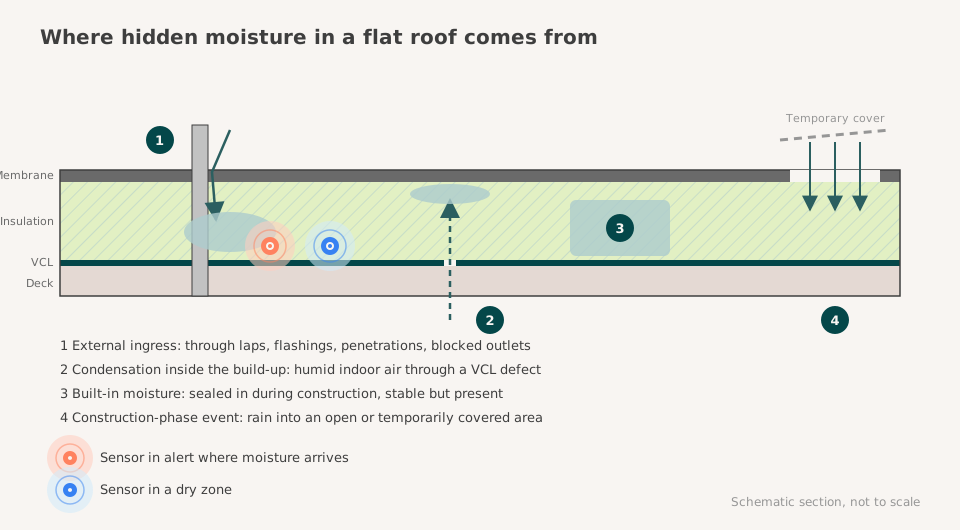
Four routes into the same sealed build-up. Schematic, not to scale.
External ingress
Water from above gets in through the membrane and its details: laps and seams that have failed, flashings and upstands at parapets, rooflights, plant bases, pipe and cable penetrations, and outlets that have been blocked long enough for water to pond and find a weak point. Ponding is the multiplier: leaves and debris in autumn, a low spot in the deck, an outlet detail that was never quite right - each keeps water standing on a membrane that was designed to shed it. Continuous readings show ingress as a rise at a position after a rain event, and the position points at the detail.
Condensation inside the build-up
Warm, moist indoor air moves upwards; the VCL is what stops it entering the insulation. A punctured VCL, a missing tape seam, a fatigued membrane at a junction, and humid air reaches a colder layer of the build-up and condenses inside it. It is often misdiagnosed as a leak, until a membrane inspection finds no breach. It is seasonal by nature: warm summer conditions drive moisture in the build-up downwards, and cool autumn nights push condensation risk up as heating comes on and the roof deck sits below dew point for long hours. The two seasonal articles cover this in detail: why condensation in flat roofs spikes in autumn and moisture in warm roofs during summer. Continuous readings show condensation as a pattern that follows temperature and season rather than rainfall.
Built-in moisture
Some moisture is in the roof from the day it is finished. It comes from a leak during construction that was not dealt with before the roof closed, from insulation that was replaced only where it was visibly wet, from a build-up that was left open to weather overnight, or from wet materials installed as delivered. Unlike a live leak, built-in moisture is a stable condition - it does not grow after each storm - but it lowers the insulation’s performance and it makes seasonal condensation more severe, so a roof carrying it looks worse in its first summer than a dry one. Continuous readings from construction onwards show whether a roof closed dry.
Construction-phase events
Roofs are at their most exposed while they are being built. Temporary covers leak, sequencing leaves areas open, trades cross a finished membrane with materials and equipment. In our Copenhagen school roofs case - four multifunctional roof surfaces on a new school - rain came in through a leaking temporary cover during construction; the sensors placed at key locations told the contractor where the water had entered and whether the roof needed further drying before it was closed. At Northgate House in Oxford, a leak during construction was caught and dealt with immediately, and the drying of the roof was supervised. Both are ordinary events on a live site; the difference is whether they were seen.
Drainage and complex roofs
A flat roof that carries gardens, stored water, solar panels or plant gives water more places to stay and more ways to get in. Green roofs hold moisture by design in their retention and drainage layers, and hide what is beneath them; blue roofs store water deliberately; solar arrays, plant and walkways add penetrations, shading and foot traffic; terraces add build-up and use. Drainage on these roofs is doing more work with less inspection access, during construction as much as in operation. That is why BESTSELLER Logistics Center West in Lelystad, a mass-timber and straw building under an extensive green roof, treats continuous monitoring as part of the moisture strategy from construction into operation, and why the school roofs in the case above - four surfaces carrying gardens, solar panels and play equipment - were monitored at their outlets and penetrations from the start.
The early signs, and their limits
The signs are familiar: stains, blistering or peeling paint on a ceiling; a persistent musty or damp smell; mould or corroded fixings in an accessible void; condensation or frost on the underside of rooflights; wet or sagging insulation when a membrane is lifted. Each of them is worth acting on.
Each of them also arrives late, and none of them answers the three questions that decide what to do: where the moisture is, since when, and whether it is getting worse. A stain is metres from its source and weeks or months behind it; a musty smell is a building-wide symptom; lifting the membrane is a repair in itself. Annual inspection sees the surface on the day; it does not see the insulation in between.
What continuous monitoring adds
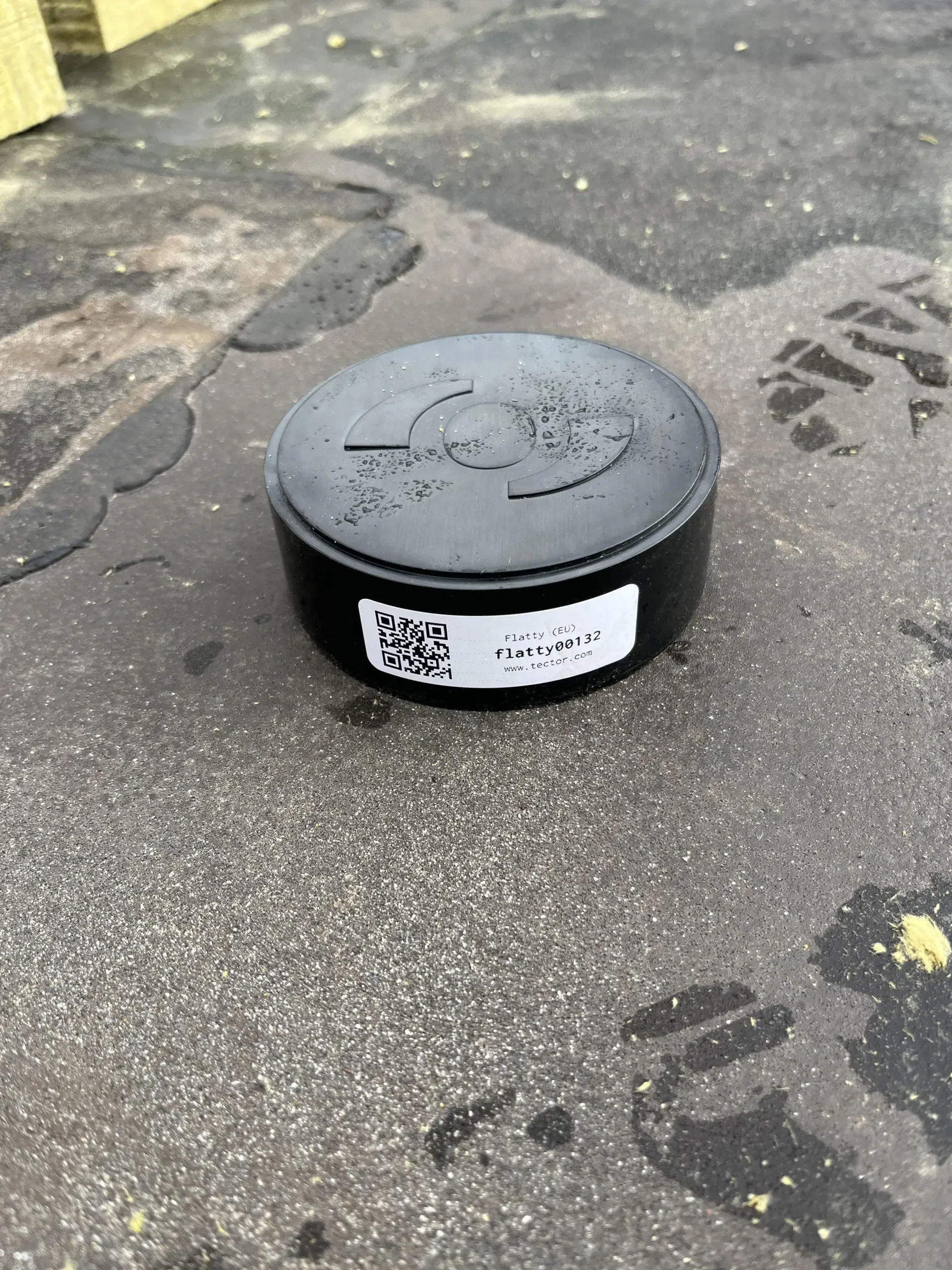
Embedded wireless sensors sit in the build-up - in a warm roof, on top of the VCL surrounded by the insulation - and report continuously from construction onwards. What that adds is the three answers the signs cannot give:
- Where - an alert names a sensor position; investigation starts there.
- Since when - the readings show when a position started to change, and whether it changed after a rain event or with the season.
- Whether it is getting worse - a trend, not a snapshot; a stable built-in condition looks different from an active ingress.
The flat-roof research with Teknologisk Institut showed why the “where” matters: water in a warm roof with mineral-wool insulation often travels to hidden cavities rather than being absorbed where it enters, and seasonal conditions move moisture down in summer and risk up in winter - behaviour that live monitoring on real roofs confirmed and laboratory tests could not fully replicate. How the system works covers detection, alerts and the risk score and analysis that put a reading in the context of the roof’s history, season and weather.
Sensors can go into a new roof with the insulation, or be retrofitted into an existing roof by drilling a small hole through the membrane, placing the sensor in the insulation layer and sealing the hole. Coverage is a planning value - indicatively a sensor every 15-25 m² in critical areas, adjusted for roof complexity and confirmed in a project assessment - and placement follows the risk: outlets, penetrations, upstands, low points, and the areas beneath installations. Specifying that in a new roof is a subject of its own; here the point is only that the moisture this article describes is measurable, in place, before it becomes damage.
When to act
If a roof is showing any of the signs above, the question is not whether there is moisture but where and since when. If a roof is being built or refurbished, the question is whether it will close dry and how anyone will know afterwards. In both cases the starting point is the same: tell us about the roof and its stage, and you receive a recommended monitoring approach, indicative coverage and placement, the installation considerations and a suggested next step.
Request a project assessment. For the system, see moisture monitoring for flat roofs.